Retreat to the Mountains: How Alpine Calm Reorders Body and Mind

Retreat to the Mountains
How the mountains bring us back to calm. And what a retreat does to us.
A retreat to the mountains often reaches deeper than one expects. Not loudly, not abruptly. More like a gradual reordering. The view expands. Noise falls away. The body follows. Breathing, pulse and inner tension begin to settle into a quieter rhythm. Research on natural landscapes, forest environments and stays at moderate altitude suggests that this combination of elevation, nature and stillness can improve subjective well-being and measurably reduce stress responses.
In the mountains, there is something more: distance. Not only from the valley, but from everyday life. Decisions feel clearer. Thoughts lose their weight. What seemed urgent begins to recede. Mountains do not create an artificial counterworld to life. They create a setting in which things begin to return to their proper place.
At Chalet Falk, set at 1,323 metres in the Nockberge mountains, this retreat takes on a particularly gentle form. Quiet, clear and understated. The calm of an alpine meadow meets open architecture, warm natural materials, expansive glazing and a level of comfort and privacy otherwise associated with first-class boutique hotels – though rarely with this same sense of space, seclusion and silence. Not a resort. Not a hotel. But a private luxury chalet in Austria, entirely your own.
Alpine clarity that resets your rhythm
In the mountains, perception begins to shift. Lines become more precise. Horizons open up. Stimuli become fewer. What sounds simple is, in truth, a rare condition. The body responds with great sensitivity to its surroundings. Studies on time spent in natural environments repeatedly show associations with lower stress levels, beneficial changes in pulse, blood pressure and cortisol, and improved mental restoration.
» Stays at moderate altitude, as found across many Alpine regions, have also been studied for years. The Austrian Moderate Altitude Studies suggest that active time spent at mid-altitude may have positive effects on several health-related parameters. Another study found that even holidays at moderate or low altitude can improve perceived health and recovery. What matters is not altitude alone, but the interplay of movement, clear air, distance from routine and a natural setting. «
Dnaiel Mars
At Chalet Falk, this effect is deepened by architecture. Clear lines. A reduced design language in an Alpine-Japandi style. Spaces that feel open without ever becoming cold. Large windows that do not merely frame the landscape of the Nockberge, but draw it inward. Here, architecture is not a performance. It becomes a quiet medium of calm.
The quiet influence of the mountains
Nature that strengthens
Alpine meadows. Larch forests. The stream. The soft, rounded peaks of the Nockberge. Views reaching as far as the Karawanken and Tauern ranges. In alpine landscapes, a sense of presence emerges that needs neither spectacle nor staging. A study on mountain meadows and near-natural alpine environments found that even short stays in such settings can positively affect stress reduction, attention and well-being. Carefully maintained alpine cultural landscapes in particular were perceived as beneficial to health.
The value of such places lies not only in their beauty, but in their effect. Natural environments ease the nervous system without asking anything of us. They let the gaze move outward – and in doing so often ease inner pressure as well. That is why days in the mountains so often feel longer, wider and lighter at once.
(internal link: Region / Nockberge / Summer in the Nockberge)
Calm that carries
Today, calm is no longer a decorative extra. It is a form of quality. Perhaps even one of the rarest. In alpine landscapes, it arises naturally: not as the absence of life, but as the absence of unnecessary stimuli. Psychological research on nature experience has long described natural environments as restorative – spaces that can reduce mental fatigue and support emotional balance.
A retreat to the mountains is therefore not a standstill. It is a return to clarity, focus and inner space. For people whose everyday lives are shaped by responsibility, decisions and constant pace, this has a particular value: not entertainment, but relief. Not programme, but substance.
Space that opens the mind
Mountains do not only calm us. They also put things back into perspective. Looking into the distance changes our inner view. What felt narrow begins to widen. What seemed fixed begins to loosen. This experience cannot be measured in full, but it is well described in both cultural and psychological terms. Encounters with nature, especially in striking landscapes, are often linked to feelings of awe, spaciousness and inner expansion. Such states can strengthen a sense of connectedness and temporarily loosen the grip of everyday stress.
Anyone standing beneath a clear night sky, far from urban light, often feels exactly that. Darkness ceases to feel like a lack and becomes a quality in itself. Research on nightscapes and stargazing suggests that darkness, visible stars and the experience of vastness can foster emotional depth, wonder and a rare form of presence.
In the mountains, a different rhythm begins
In the mountains, a different rhythm begins. Not because we plan it. But because the place itself sets the tone. We wake differently. We move more slowly. Conversations grow longer. Meals become calmer. Even the simplest walk feels more self-evident. The day loses its fragmentation and regains a natural sense of order.
In a private chalet, this shift becomes even deeper. No lobby. No frequency of other guests. No shared spaces. No constant awareness of the outside world. Instead: space, stillness and the quiet relief of not having to explain yourself. This form of privacy is not a detail. It is an essential part of restoration. Retreat works best where one is not being watched.
(internal link: Your Stay / privacy / Prices & Availability)
Chalet Falk – a retreat that deepens this effect
Chalet Falk is not simply a house in the mountains. It is a place that receives the effect of the mountains and carries it further with intention. Open architecture. Natural materials. Harmonious, warm tones. A design language that does not speak of calm, but allows calm to emerge.
Outside, an alpine meadow where cows graze in summer. The steady, gentle sound of the stream. The open lines of the Nockberge. A landscape that feels wide without being dramatic. That is precisely where its strength lies. The Nockberge do not demand. They support. They open. They lend the stay a softness that has become rare in the Alps.
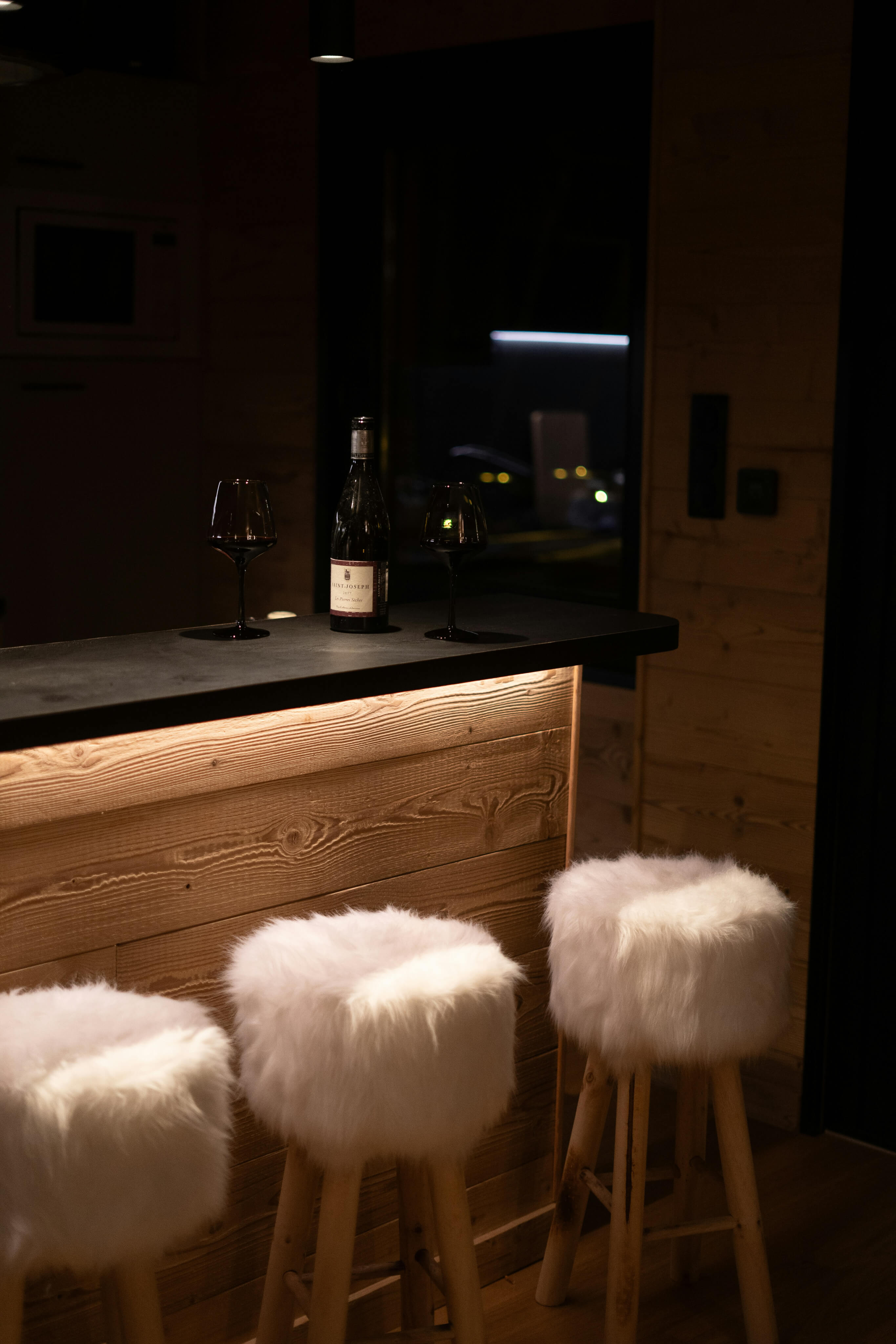
And at the same time, this is where those moments arise that continue to resonate long after. A sundowner by the outdoor fire pit as the peaks catch the last light of day. Stargazing from the 33°C heated pool beneath one of Europe’s darkest skies. A good glass of red wine by the open fireplace. First light over the meadow. The quiet view outward, before the day begins.
(internal link: Private Spa / pool / The Chalet)
The most valuable part of time away is often not a programme or a checklist, but the moments shared with the people who matter. Time with a partner. With family. With best friends. Or simply with oneself. Chalet Falk was created for exactly this kind of retreat: a private luxury chalet in the mountains, where calm, space and discreet exclusivity come together in a rare and natural way.
“It is one of those rare places where you truly come to rest,” says Daniel Marschalt, host and owner of Chalet Falk. “The stream, the clear mountain air, that night sky – it changes something in you.”
(internal link: Your Host)
A retreat that stays with you
Not every journey changes something. A retreat to the mountains can. Perhaps precisely because it forces nothing. It creates the conditions in which calm can return. Gentle elevation. Clear air. Space. Nature. Light. Silence. And a place that does not stage any of it, but lets it become natural.
When you arrive in the mountains, you first notice the landscape. And a little later, yourself.
For those seeking exactly this kind of mountain retreat, Chalet Falk offers a place where alpine calm, architectural clarity and discreet privacy come together in a quietly exceptional way.
(internal link: Prices & Availability / EN page)
Scientific foundation & sources
The following studies and academic sources support key ideas in this article relating to nature experience, stress reduction, restoration, moderate altitude and the effect of alpine landscapes:
- Austrian Moderate Altitude Studies (AMAS): benefits of exposure to moderate altitudes (1500–2500 m)
- Austrian Moderate Altitude Study 2000 (AMAS 2000)
- Vacation at moderate and low altitude improves perceived health in individuals with metabolic syndrome
- Health-Related Effects of Short Stays at Mountain Meadows, a River and an Urban Site
- Management of mountainous meadows associated with biodiversity attributes and health-related ecosystem services
- Effects of forest bathing on cortisol levels
- Effect of forest bathing on human health
- A review of field experiments in 24 forests across Japan
- Forest experience and psychological health benefits: the state of the evidence
- Nature’s contributions to people in mountains: A review
- The Value of Darkness
- Studies on awe, nature experience and the emotional effect of expansive landscapes