Silence is a gift. Why killing time is a huge win.

There is a particular kind of silence in the mountains. It is not complete. A stream runs past the house. Timber settles as the temperature drops. Somewhere beyond the meadow, wind moves through the larch trees. In winter, snow absorbs the harder sounds. In summer, insects and birds take over the spaces between them.
This silence is not empty. It is simply free of demands. That distinction matters.
Most of us rarely experience true quiet anymore. Even when nobody is speaking, something is still calling for attention: a screen, a message, a meeting, a route to plan, a restaurant to reach, a place that should be seen before the day is over. We have learned to treat unoccupied time as a problem. A gap to fill. A sign that we might be missing something.
Perhaps the opposite is true. Perhaps silence is one of the few remaining forms of luxury precisely because it cannot be consumed quickly. It asks for no response. It does not compete. It gives time back rather than taking it.
The discomfort of doing nothing
“Killing time” does not sound particularly ambitious. The phrase suggests waste. Time should be used, organised or improved. Even a holiday can become a project: breakfast at eight, first lift at nine, lunch reservation at one, spa treatment at four, dinner at seven-thirty.
The surroundings may be different, but the rhythm remains familiar. This is why doing nothing can initially feel uncomfortable. The mind continues to search for the next task long after the schedule has stopped. A phone is picked up without reason. Silence is filled with music. A view is photographed before it has really been seen.
It takes a while to arrive somewhere physically. It often takes longer to arrive mentally.
A mountain retreat gives this process room. Not because the mountains automatically make people calm, but because they remove much of what normally interrupts calm before it can begin. There are fewer decisions. Fewer people. Fewer movements outside the window. The distances between things become more noticeable. And then, slowly, the idea of doing nothing changes. It stops feeling like lost time. It begins to feel like time recovered.
Why the mountains change our sense of time
In the city, time is measured in appointments, traffic and deadlines. In the mountains, it becomes visible in other ways.
Light moves across a slope. Clouds form above a ridge. The shade reaches the meadows on the opposite of the mountain stream and the terrace. The temperature falls as soon as the sun disappears behind the trees. Nothing happens suddenly, yet the day is never static.
This is part of the quiet appeal of a holiday in the mountains or a stay on an alpine meadow. The landscape does not perform for its visitors. It continues at its own pace, whether someone is watching or not. That pace is difficult to resist.
A morning may begin without an alarm. Breakfast lasts longer because no table is needed by someone else. A walk starts directly outside the door and ends whenever it ends. The sauna is used not because a time slot has been booked, but because the body wants warmth. The day becomes less about sequence and more about attention. You notice the cold floor beneath your feet. The sound of water outside. The first fire of the evening. The difference between the air before and after rain.
These are small observations. They are also the moments from which a place like CHALET FALK is later remembered.
Privacy is what allows silence to remain
Silence is fragile. It changes when strangers enter a room, when a door opens repeatedly or when private time has to be coordinated with other people.This is why privacy is not separate from rest. It is one of its conditions. A private chalet like CHALET FALK offers a kind of freedom that even the most beautiful hotel cannot fully reproduce. There is no lobby to pass through, no shared corridor, no timetable for breakfast and no need to check whether the spa is busy.
The house belongs to one group. The rooms, the garden, the sauna, the pool and the terrace are used without negotiation. This changes behaviour in subtle ways. You stay longer at the table. You enter the pool early in the morning or late at night. You sit in the sauna without thinking about who might come in next. You speak when there is something to say and remain quiet when there is not. Privacy removes the pressure to perform a version of leisure. It allows people to relax each in their own way.
For some, that means long conversations. For others, reading in separate rooms. One person may walk through the woods while another stays beside the fire. Togetherness no longer requires constant proximity. A house with enough space can always hold both.
The chalet as a place, not a programme
The best retreats do not tell their guests what to feel. They provide the conditions and then step back.
Architecture plays a central role in this. A room can stimulate, impress or distract. It can also create calm.
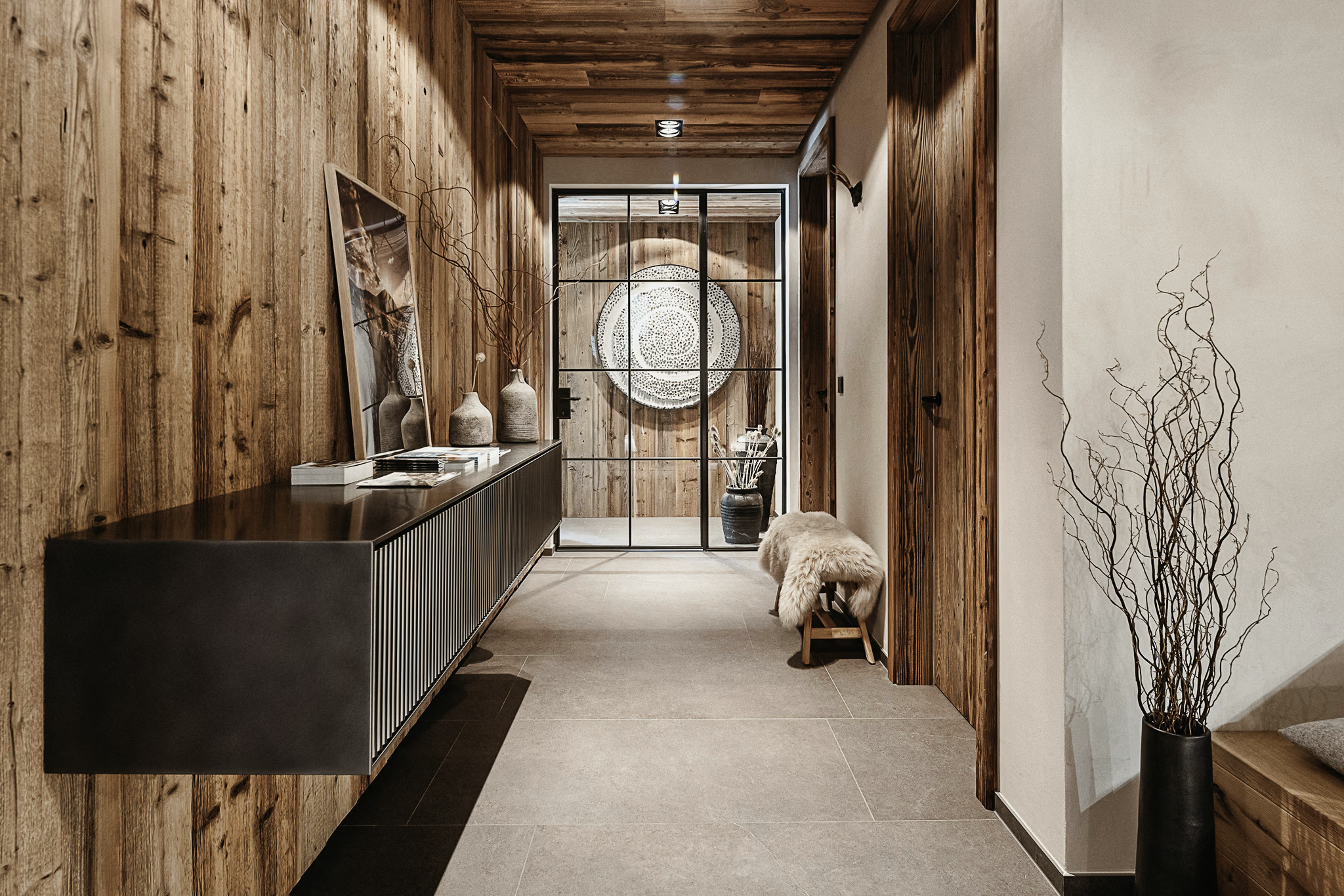
At CHALET FALK, natural materials, warm light and clear proportions allow the eye to settle. Large windows connect the interior to the landscape without turning the view into decoration. A fireplace gives the evening a centre. Separate en-suite bedrooms with their own private bathrooms make it possible to withdraw without leaving the shared experience entirely.
The chalet opens towards the meadow, the stream and the Nockberge Mountains. The private spa is part of the architecture rather than an additional facility somewhere else. The panoramic sauna looks out into the landscape. The heated outdoor pool carries the warmth of the house into the garden. The relaxation room offers protection without removing the sense of being in the mountains. Each space frames the landscape in a slightly different way, yet the effect is always the same: the view draws your attention outward and allows everything else to slow down. Nothing needs to be scheduled. The sauna, pool and relaxation room remain available whenever the moment feels right.
That availability is more valuable than constant activity. It means the day can unfold rather than be managed.
The value of an unplanned afternoon
There is a moment during a longer stay when the pressure to make use of the holiday begins to fade. Perhaps it happens after a walk. Perhaps after lunch. No one has made a plan for the afternoon. The weather is neither good nor bad. The fire is still burning. Someone makes coffee. Another person lies down. The pool is warm, but nobody feels the need to enter it immediately. Nothing remarkable happens.
And yet, this may become the part of the holiday that remains most clearly. Not because it produced a story, but because it produced a feeling: there was enough time. Enough time to sit without checking the hour. Enough time to let a conversation disappear and return. Enough time for thoughts to finish themselves.
This is what “killing time” can mean when it is no longer treated as waste. It means refusing to turn every hour into output. It means allowing time to pass without extracting something from it.
Silence does not mean isolation
A silent retreat does not have to be solitary. Silence between people can be comfortable when nobody feels responsible for filling it. It is one of the signs that a group has settled into a place. Families experience this differently from couples. Friends differently from colleagues. Yet the principle remains the same: people become more present when there are fewer competing signals. Meals become longer. Children spend more time outside. Phones remain in other rooms. Conversations move beyond the efficient exchange of information.
The mountains help because they offer scale. They remind us that not everything needs to be immediate. The landscape existed before the visit and will continue after it. The chalet becomes a temporary home within something much larger and less hurried. This perspective can be deeply reassuring. It reduces the importance of minor disruptions. It makes space for curiosity. It allows a group to be together without having to entertain itself continuously.
Silence, in this sense, is not withdrawal from life. It is a different way of participating in it.
What remains after the quiet
The value of silence often becomes clear only after returning home. The noise returns. Messages accumulate. The familiar pace resumes. But some part of the slower rhythm remains. Perhaps breakfast is allowed to last a little longer on Sunday. Perhaps a walk is taken without headphones. Perhaps there is less urgency to answer every message immediately. A quiet holiday does not transform life completely. Nor should it need to. Its effect can be smaller and more useful: it reminds us that attention is finite, that privacy has value and that time does not always need to be optimised.
A chalet in the mountains cannot stop the world outside. But, it can, at least for a few days, make it less important. The stream continues past the garden. The meadow darkens. The water in the pool remains warm. There is no appointment to reach and no room that must be vacated.
Nothing is happening.
And that is precisely the point.